
Henri Kagan is a French chemist whose work has had a major influence on modern organic chemistry and asymmetric catalysis. After decades of research, his name has become closely associated with the study of chirality—the phenomenon in which molecules can exist in two mirror-image forms.
Born in France in 1930, Kagan built a long academic career around stereochemistry, organic synthesis and asymmetric reactions. He later became professor emeritus at the former Université Paris-Sud, now part of Université Paris-Saclay. CTHS
His scientific contributions are particularly important because controlling the shape of molecules can be crucial when developing medicines and other biologically active compounds.
The Franklin Institute describes Kagan as a pioneer of asymmetric catalysis whose discoveries had a significant impact on pharmaceutical chemistry. The Franklin Institute
Read Also: CJ Carr: Biography, Girlfriend, Age, Height, Family, Career, Education & More
Quick Bio of Henri Kagan
| Details | Information |
|---|---|
| Full Name | Henri Boris Kagan |
| Born | December 15, 1930 |
| Birthplace | Boulogne-Billancourt, France |
| Nationality | French |
| Profession | Chemist, Researcher and Professor |
| Field | Organic Chemistry, Stereochemistry, Asymmetric Catalysis |
| Education | École nationale supérieure de Chimie de Paris, Sorbonne; doctorate from Collège de France |
| University Career | Université Paris-Sud / Orsay |
| Academic Status | Professor Emeritus |
| French Academy of Sciences | Elected member in 1991 |
| Known For | Pioneering work in asymmetric catalysis and stereochemistry |
| Major Scientific Contribution | Development and understanding of methods for controlling molecular chirality |
The biographical details above are supported by French scientific and academic sources, including the Académie des sciences and the Comité des travaux historiques et scientifiques. CTHS
Who Is Henri Kagan?
Henri Kagan is a French organic chemist best known for his research into asymmetric synthesis and catalysis. In simple terms, his research helped chemists understand how to make chemical reactions favor one particular three-dimensional form of a molecule over its mirror image.
This is important because molecules that look almost identical on paper can behave very differently inside the human body. A molecule and its mirror image may have different biological effects, which makes controlling molecular structure an important part of pharmaceutical research.
Kagan’s career developed during a period when chemists were increasingly trying to control reactions at the molecular level rather than simply producing mixtures of chemical compounds.
His research eventually made him one of the best-known figures in asymmetric chemistry. The Franklin Institute recognized him for fundamental discoveries explaining how the shape of a catalyst influences its ability to control chemical reactions. The Franklin Institute
Read Also: Aaron Pierre Parents: Net Worth, Wife, Family, Biography, Early Life & Career
Age and Early Life
Henri Kagan was born on December 15, 1930, in Boulogne-Billancourt, France. According to the French historical and scientific records, he trained in chemistry in Paris and obtained his engineering qualification from the École nationale supérieure de Chimie de Paris in 1954. He also studied at the Sorbonne. CTHS
He completed his doctorate in physical sciences in 1960, with research prepared at the Collège de France under J. Jacques. His early scientific career also included a postdoctoral period at the University of Texas at Austin. CTHS
That education gave Kagan a strong foundation in organic chemistry and stereochemistry, fields that would become central to his later research.
Education and Academic Career
Kagan’s professional life was closely connected with scientific research in France. After his early work with the French National Centre for Scientific Research, he developed his academic career at Orsay and eventually became a professor at Université Paris-Sud. CTHS
He spent nearly four decades connected with the university, according to the Franklin Institute, and later became professor emeritus. Even after his formal academic career, he remained involved in scientific activities, including lectures and mentoring. (Source: The Franklin Institute)
His work also earned recognition from scientific institutions around the world. Among his honors are the Wolf Prize in Chemistry, the Prelog Medal, the Nagoya Medal of Organic Chemistry and several other major scientific distinctions. (Source: The Franklin Institute)
Why Henri Kagan Became Important in Chemistry
One of the central ideas behind Kagan’s work is molecular handedness, also called chirality.
Just as your left and right hands are mirror images but cannot be perfectly superimposed, some molecules also occur in two mirror-image versions. These versions are known as enantiomers.
For chemists, the challenge is often to produce mostly one of these forms rather than a mixture of both.
Kagan’s research helped advance techniques that allow chemists to control this process. His work therefore became especially relevant to the development of pharmaceutical compounds, where the precise structure of a molecule can matter enormously.
Henri Kagan’s scientific career reached a historic milestone on October 7, 2026, when he and Japanese chemist Kenso Soai were announced as the winners of the 2026 Nobel Prize in Chemistry.
The Royal Swedish Academy of Sciences awarded the prize for their discovery of non-linear effects and autocatalysis in asymmetric organic synthesis. Their work helped explain one of chemistry’s long-standing questions: why living systems strongly favour one mirror-image form of certain molecules. Académie des Sciences
Why Did Henri Kagan Win the 2026 Nobel Prize?
Kagan’s research focused on asymmetric synthesis, where chemists try to produce one preferred version of a molecule rather than an equal mixture of its two mirror-image forms.
Think of your left and right hands. They are mirror images, but you cannot place one exactly on top of the other. Some molecules behave in a similar way. These mirror-image molecules are called enantiomers.
This matters greatly in medicine because two molecular forms can interact differently with the human body. One may provide the desired effect while another can have a different or unwanted biological effect. Royal Society of Chemistry
Kagan’s experiments in the 1980s demonstrated that a small initial imbalance in molecular handedness could be amplified through a chemical reaction. This became an important clue in understanding how one molecular form could become dominant. Nature
Henri Kagan and DIOP
One of the important achievements associated with Kagan’s career was his work on DIOP, a chiral ligand that became influential in asymmetric catalysis.
His research helped establish how specially designed chiral molecules could influence the behaviour of catalysts and guide chemical reactions toward a particular molecular configuration.
This was part of a much broader transformation in organic chemistry. Instead of simply asking whether a reaction could produce a compound, researchers increasingly wanted to control which three-dimensional form of that compound was produced.
Kagan’s contribution helped make that level of control possible.
Henri Kagan’s Research and the Origin of Molecular Chirality
The 2026 Nobel Prize also highlights a fascinating question about the origin of life.
Many important molecules associated with living organisms show a strong preference for one molecular handedness. This phenomenon is known as homochirality.
Kagan’s work showed that chemical systems can amplify a very small initial imbalance rather than simply maintaining a 50–50 mixture. Kenso Soai later demonstrated an especially powerful example of asymmetric autocatalysis.
Together, their work provided a major piece of the scientific explanation for how molecular handedness can emerge and become strongly dominant. Nature
Henri Kagan Awards and Honours
Henri Kagan had already received numerous major scientific honours before his Nobel Prize.
Some of the best-known include:
- Wolf Prize in Chemistry – 2001
- Bower Award and Prize for Achievement in Science – 2005
- Prelog Medal
- Nagoya Medal of Organic Chemistry
- Tetrahedron Prize for Creativity in Organic Chemistry
- Ryoji Noyori Prize
- Grand Prix de la Fondation de la Maison de la Chimie
- Chevalier de la Légion d’Honneur
- Silver Medal of the French National Centre for Scientific Research
- Election to the French Academy of Sciences in 1991
The Franklin Institute describes Kagan as a pioneer of asymmetric catalysis and notes the broad influence of his discoveries on pharmaceutical chemistry. The Franklin Institute
The Wolf Foundation had previously recognised Kagan, Ryoji Noyori and K. Barry Sharpless for pioneering work in asymmetric catalysis and the synthesis of chiral molecules. Wolf Fund
Henri Kagan Nobel Prize 2026
The 2026 Nobel Prize in Chemistry is arguably the biggest recognition of Kagan’s career.
Kagan and Soai will share the Nobel prize amount of 12 million Swedish kronor. The official ceremony is scheduled for December 10, 2026, in Stockholm. Académie des Sciences
Kagan is 95 years old in 2026, making the recognition particularly notable after a scientific career spanning many decades. Reuters reported that the Nobel Committee initially had difficulty reaching Kagan after the announcement. Reuters
The award also has historical significance because Kagan had previously been left out when the 2001 Nobel Prize in Chemistry recognised major advances in catalytic asymmetric synthesis. That earlier decision had generated controversy among French chemists and others who considered Kagan’s contribution fundamental to the field. AFP
Family and Personal Life
Henri has spent much of his public life focused on scientific research, teaching and mentoring.
Reliable public sources provide extensive information about his scientific career, education and awards, but detailed information about his wife, children and wider family is not consistently documented by authoritative sources.
For that reason, it would not be appropriate to publish unverified names or personal details simply to fill a biography section.
This is especially important for biography content because readers should be able to distinguish between confirmed information and internet speculation.
Henri Kagan Net Worth
There is no reliable publicly verified figure for Henri Kagan’s personal net worth.
As an academic scientist, Kagan’s publicly documented career is primarily associated with universities, research institutions, scientific awards and academic work. His Nobel Prize also provides a clearly reported prize amount, but that does not establish his total personal wealth.
Therefore, websites claiming a specific figure for “Henri Kagan net worth” should be treated cautiously unless they provide credible financial documentation.
For this reason, it is better to state that Henri Kagan’s net worth is not publicly known rather than inventing an estimate.
Legacy
Henri Kagan’s legacy goes far beyond the 2026 Nobel Prize.
His research helped transform asymmetric chemistry from an important scientific idea into a practical tool for controlling molecular structure. His work influenced areas including organic synthesis, catalysis and pharmaceutical chemistry.
The significance of his research can be understood simply: when scientists manufacture a biologically active compound, getting the correct molecular form can be just as important as producing the compound itself.
The Royal Society of Chemistry says Kagan and Soai’s discoveries have been decisive for chemists designing reactions used in pharmaceutical manufacturing. Royal Society of Chemistry
After decades of research, Kagan’s 2026 Nobel recognition therefore represents not just an individual achievement but recognition of a scientific field that has changed how chemists think about molecular handedness.
Frequently Asked Questions About Henri Kagan
Who is Henri Kagan?
Henri Kagan is a French organic chemist and professor emeritus known for pioneering research in asymmetric catalysis and molecular chirality.
How old is Henri Kagan?
Henri Kagan is 95 years old in 2026. He was born on December 15, 1930.
Why did Henri Kagan win the Nobel Prize in Chemistry 2026?
He shared the 2026 Nobel Prize in Chemistry with Kenso Soai for discoveries concerning non-linear effects and autocatalysis in asymmetric organic synthesis. Académie des Sciences
What is Henri Kagan famous for?
He is particularly famous for his pioneering work in asymmetric catalysis, chiral molecules and the amplification of molecular handedness.
Is Henri Kagan married?
Reliable authoritative sources do not provide enough consistent information about his marital status and family life to state this confidently.
What is Henri Kagan’s net worth?
His personal net worth has not been publicly verified.
Where did Henri Kagan work?
He built most of his academic career at Orsay and Université Paris-Sud and is now a professor emeritus. The Franklin Institute
Final Words
Henri Kagan’s journey is a remarkable example of how decades of fundamental research can eventually answer a question that connects chemistry with the origins of life.
His 2026 Nobel Prize recognises research that began long before the award and helped scientists understand how tiny molecular differences can become strongly amplified. His work continues to influence chemistry, pharmaceutical research and the study of chirality.
For redstargroup.in, this article should be published with clear sourcing and an author/date section, especially because the Nobel announcement is a very recent 2026 development.
Author Profile

- Vivek Agarwal is an experienced content writer with over 5 years of expertise in blogging and digital publishing. Having completed his education in English Generalism, he specializes in creating SEO-friendly, research-based, and reader-focused content. At RedStarGroup.in, he covers biographies, entertainment news, trending topics, and informative articles.
Latest entries
 BiographyOctober 7, 2026Alina Charaeva: Biography, Age, Family, Career, Net Worth & Latest Updates
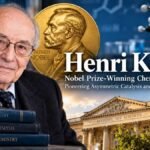 BiographyOctober 7, 2026Henri Kagan: Biography, Age, Family, Career, Net Worth & Latest Updates
 BiographyOctober 3, 2026CJ Carr: Biography, Girlfriend, Age, Height, Family, Career, Education & More
 BiographyOctober 1, 2026Vedang Raina Biography, Net Worth, Family, Parents, Wife, Early Life & Career